If you had been buying Bitcoin since January, here’s how much you’d have now

Buying Bitcoin in small amounts on a schedule is called Dollar-Cost Averaging (DCA). You set a fixed amount to buy at regular intervals, no matter the price. The goal is to avoid trying to guess the perfect time to buy. This approach helps soften the effect of price swings, especially during months when Bitcoin moves up and down a lot.
This article looks at how much Bitcoin you would have today if you had been buying since January 1, 2025, up to November 10, 2025.
The year has been intense for Bitcoin. It climbed to about $124,000 in August, then dropped below $100,000 in October before settling around $106,477 by November 10.
The question is simple. If you stayed consistent, would your small daily, weekly, or monthly buys still make sense, even during the big price drop? The data shows that staying consistent helped lower the average cost. So when the price fell, your steady buying helped balance the high points and the low points.
All values in this analysis are based on the Bitcoin price of $106,477 as of November 10, 2025.
How the calculation was done
This analysis covers the period from January 1, 2025, to November 10, 2025. That is 313 days. To ensure the accuracy of the results, each Bitcoin purchase was matched with the Bitcoin price on the exact day the purchase would have occurred. No averaging or smoothing was used. The goal was to reflect what you would experience if you were actually buying on a schedule.
This study compared three common buying habits:
- Daily Buyer: You set $1 to buy every day. This resulted in 313 purchases, totalling $313 spent.
- Weekly Buyer: You buy $10 every week. This resulted in 45 purchases, totalling $450 spent.
- Monthly Buyer: You buy $40 each month. This resulted in 10 purchases, totalling $400 spent.
Handling price data
Bitcoin reached a high of above $124,000 during the year, then later fell below $100,000 before settling at approximately $106,477 on November 10.
This period was a good test for Dollar Cost Averaging (DCA) because it included both high points and deep pullbacks. When you continue to buy during both periods, your average entry price adjusts over time. The goal of DCA is not to catch the lowest price but to benefit from the average of the ups and the downs.
All final values in this analysis are based on the closing price of $106,477 on November 10, 2025.
How each buying strategy performed
The main difference between the three strategies is how often you buy. Buying more often spreads your entry price across many price points. Buying less often puts more weight on the price of a few specific days.
1. Daily buyer: $1 every day
You buy $1 worth of Bitcoin every day. That is 313 small buys.
- Total invested: $313
- Total Bitcoin: 0.00355 BTC
- Average cost per BTC: $88,169.01
Because you bought a tiny amount every day, your entries were spread widely across all the ups and downs. Even when Bitcoin was expensive, you only bought $1 worth, which protected you from overpaying. This approach gave the lowest average cost among the three strategies.
2. Weekly buyer: $10 every week
You buy $10 once a week. That produced 45 buys.
- Total invested: $450
- Total Bitcoin: 0.00508 BTC
- Average cost per BTC: $88,582.68
This strategy bought more Bitcoin overall because the total spend was higher. The average cost remained close to the daily plan because you continued to make regular purchases. This plan resulted in the largest total Bitcoin holding and the highest dollar value as of today.
3. Monthly buyer: $40 each month
You buy once a month. That is 10 buys.
- Total invested: $400
- Total Bitcoin: 0.00445 BTC
- Average cost per BTC: $89,887.64
Since you only bought 10 times, the exact day you made the purchase mattered a lot. If your monthly purchase happened to occur during a high-price month, it pulled your average cost up. This was the most sensitive strategy and ended with the highest average cost.
What the results show
Comparative results of BTC DCA strategies (Jan 1 – Nov 10, 2025)
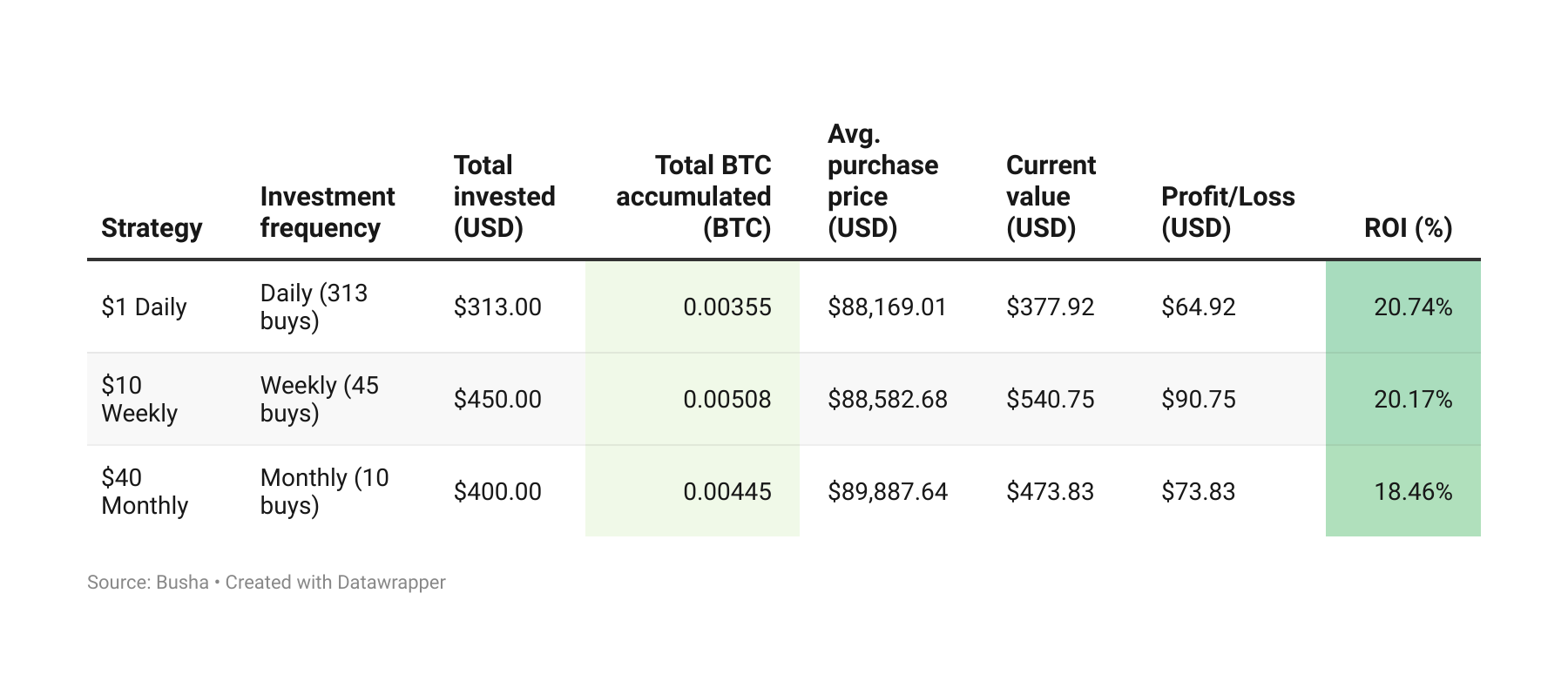
All three strategies made a profit by November 10, 2025. The total amount invested across the daily, weekly, and monthly plans was $1,163. The combined value at the end of the period was about $1,392.50.
The main factor that shaped the result was how often you bought. The daily plan had the lowest average cost because it spread purchases across many different price points. The weekly plan invested more money overall, resulting in the highest total profit in dollars. The monthly plan had the highest average cost because each buy carried more timing risk, especially during months when Bitcoin was trading near its peak.
Buying more often keeps your average cost steady. Buying less often leaves your results more exposed to whatever the market price is on just a few days.
Why consistency matters more than timing
The power of this approach becomes clearer when examining longer time periods.
Someone has been buying $30 worth of #Bitcoin daily for the last 8 years, turning $86,000 to $1 MILLION 🤯
— Vivek Sen (@Vivek4real_) November 8, 2025
WHAT A LEGEND! pic.twitter.com/NAi3J4eknh
Someone shared on X (formerly Twitter) that they have been buying $30 worth of Bitcoin every day for eight years. They spent a total of approximately $86,000. Today, that stack is worth about $1 million. That outcome did not happen because they bought at the perfect time. It happened because they kept going and refused to stop during the dips.
The difference between an eight-year result like that and the 10-month results in this analysis shows something simple: time and consistency matter more than trying to buy the exact bottom.
The key idea
Bitcoin moves up and down often. Trying to guess the perfect day to buy is stressful and rarely works. A consistent schedule removes the pressure to “get it right.” When the price drops, your scheduled buy simply gets you more Bitcoin for the same amount of money. When the price rises, you are already holding some.
Staying consistent allows you to benefit from the overall long-term trend instead of reacting emotionally to short-term movements.
Staying consistent with Busha
The hardest part of Dollar-Cost Averaging is sticking to it. Buying small amounts regularly may sound simple, but people often forget, delay, or stop when the market fluctuates. Automation removes that problem. Once your schedule is set, the buys happen on their own.
Recurring buy on Busha
Busha lets you automate your Bitcoin purchases. You choose the amount you want to buy and how often you want it to happen. It can be daily or weekly. You do not need a large budget. You can start with something small and steady. This makes it easier to stay consistent without needing to consider timing or price movement.
The Busha stack race
To encourage consistency, Busha created the Stack Race. It runs from October 13 to December 28, 2025. You set a savings goal, fund your Busha wallet, and turn on Recurring Buy. As long as your automated buys continue to run, you stay in the race. You earn weekly rewards for maintaining your streak. It turns saving into something simple to follow and easier to stick with.